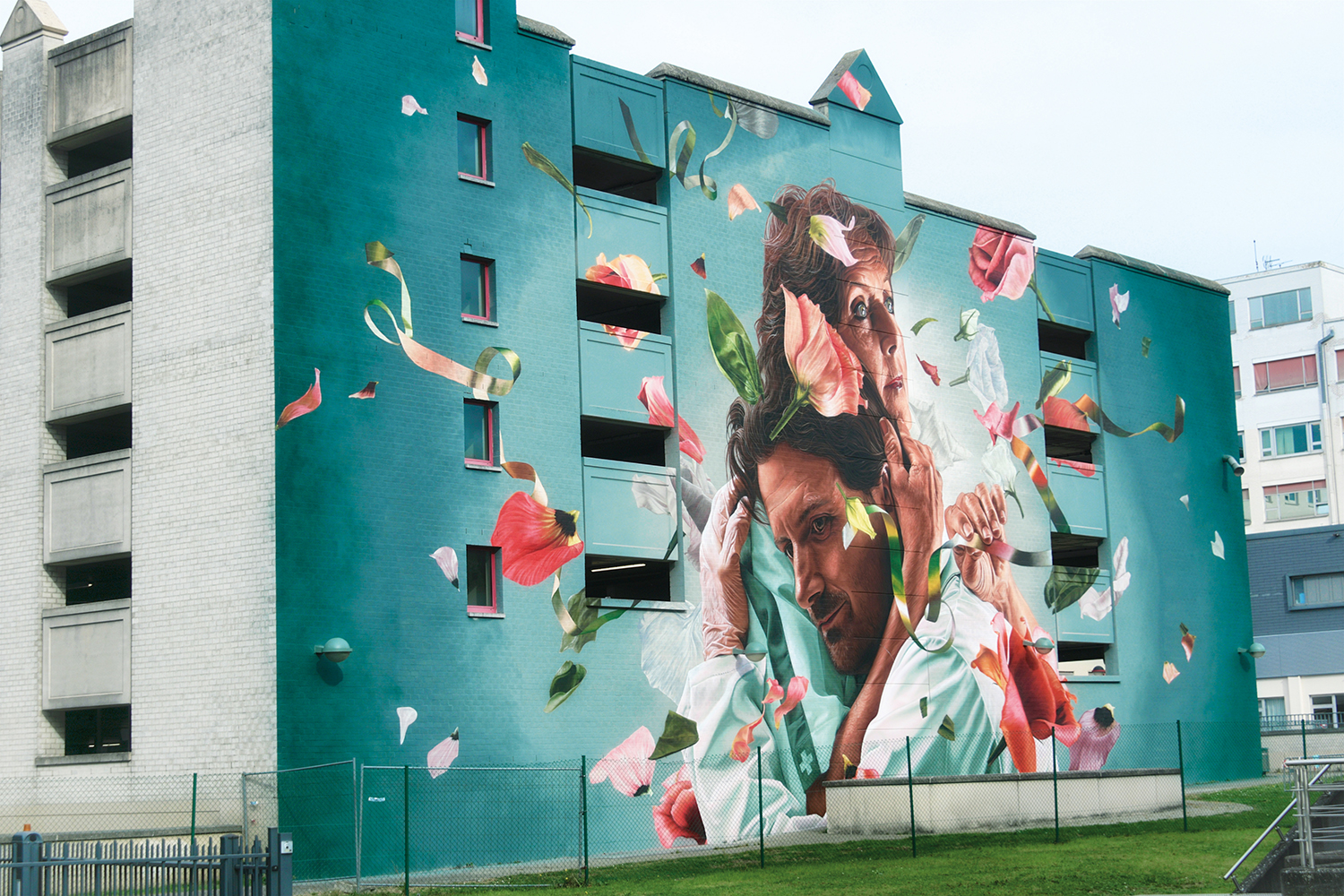
Le Petit-Quevilly, a hub of urban art
This town on the outskirts of Rouen can indeed boast a collection of nine original urban artworks.
Making art accessible to everyone—this definition of urban art, one among many—takes on its full meaning in this city of just under 23,000 residents. As part of the redevelopment of Avenue Jean Jaurès—a multimodal corridor featuring tram lines, car lanes, bike paths, and pedestrian walkways—in the heart of the city, the municipality conceived the idea of commissioning an artistic project as original as it is ambitious, the execution of which was entrusted to Urban Art Agency (U2A). This agency, based in Paris and Marseille and founded in 2018 by Sébastien Lis and Julien Dufossey following careers in the nonprofit sector, develops custom artistic projects in public spaces, working closely with the local community and its residents. Notable projects include the Label Valette festival, the Gien water tower in the Loiret region painted by Taquen, and the façade of the Point Éphémère in Paris’s 10th arrondissement, created by Potter as part of the Olympic and Paralympic Games.


People First
For this project, U2A simply won the bid. According to Sébastien Lis, “aside from our obvious talent and professionalism [laughs], I think we convinced the steering committee members by being proactive: a turnkey solution combining artist selection, outreach, and support for young students in both school and after-school settings. It wasn’t just about hanging artworks on walls, but about creating a meaningful intervention that engages in a genuine dialogue with the place and its residents. As an anecdote, when we presented our project, we had just come from a job site without having had time to change, and our clothes were still stained with paint. This detail, it seems, proved to the committee that we were truly rolling up our sleeves.”
Among U2A’s many projects, this one stands out for its duration. “This is the first time we’ve committed to a three-year project with a local government that has placed such long-term trust in us.” This project also offered a broad scope for experimentation: “working not only on walls, but also on street furniture and various installations; proposing a wide variety of styles, from abstract to figurative to illustrative.” It is also its human dimension that makes it unique. “Le Petit-Quevilly is a working-class town, and residents likely appreciate our work more here than in more affluent neighborhoods. Their feedback touches us deeply. With Julien, we have always placed people at the center, whether in our artistic or professional relationships. We’ve also given residents small mementos, including prints signed by Pantonio for the 72 residents of the building whose facade he just painted. A simple gesture so that everyone can take a little art home with them.”
A Rigorous
Selection Process The relationship of trust between municipal representatives and U2A leaders is undoubtedly one of the reasons for this project’s success. “The steering committee gave us a few themes—gender equality, the relationship between humans and their environment, living together…—which we were able to adhere to while still giving the artists enough freedom to truly express themselves,” notes Julien Dufossey. After selecting the locations, defining the mediums, and obtaining the necessary authorizations from the relevant parties, the next step was to select the artists. “The lineup took shape gradually. We made proposals as we went along, with different profiles, tailored to each location, seeking complementarity and diversity. Some artists would have liked to participate but it wasn’t possible for financial reasons. In the end, we found the right people.”
While most of the works bear the signature of French artists—with the exception of the Belgian artist Jaune for the final mural—the choice of Pantonio was a natural fit. “For us, it was a no-brainer! We actually insisted that it be entrusted to him, and the committee quickly agreed,” recalls Julien. “With his fluid style, Pantonio could soften the geometric rigidity of the facade and, through his mastery of movement, break up the overly strict lines.” And the result lives up to expectations!

PANTONIO: FULL TRANSPARENCY
This artist, originally from the Azores and now based in Lisbon, has established himself as a master of movement, with his characters, fantastical animals, fish, turtles, and rabbits, all characterized by fluid, instantly recognizable lines. For the mural adorning the facade of a building in the Jaurès residence owned by CDC Habitat, he chose continuity with birds but also originality through a remarkable play on transparency.
How did you get involved in this project?
I was contacted by Urban Art Agency, and as soon as I saw the photo of the site, I immediately agreed. The challenge was clear: working with the architecture, the building’s constraints, the limited space… and those prominent balconies that define the entire facade.
Did you have any pleasant or unpleasant surprises when you arrived on site?
Some very pleasant surprises! First, when I discovered the quality of the surface: an exceptional stucco with a unique texture that allowed me to achieve some amazing effects. Sometimes the surface is perfect, but so smooth that you can hardly do anything with it. Then there’s the color of the trees, which blends perfectly with my artwork.
How did you choose your subject?
I’m at an age where I simply crave poetry, where I want to see things as they are. I don’t have a message to convey; I just want to let the poetry of what I paint speak for itself. I don’t have a message to convey—just the desire to paint freely, a kind of declaration of love. In this mural, the birds playing among the hanging sheets evoke this relationship between humans and their environment, even though I had no constraints for this project.
Speaking of which, does this idea allow you to explore transparency—something that seems new in your work?
Transparency is, above all, a technique. I’ve been painting since I was 13 and haven’t stopped since, so thankfully I’ve got a bit of a handle on it [laughs]. In nature, transparency is a play of light; in painting, it emerges through successive layers. Here, the rough plaster allowed me to play with it differently, by applying color only to the surface of the bumps. It was interesting. That’s what being creative is all about: doing something different every day without letting yourself get stuck in a rut.
Are you satisfied?
An hour after finishing a piece, you’re never really satisfied [laughs]. I’m still in the emotional phase, not yet in the analytical one. There are things I like—the composition, the movement—and others I could have improved—the shape of the clothespins, a bit too realistic and not suggestive enough, or the white color of the sheets. Even the security guard at the mall pointed that out to me [laughs]. But you have to know how to accept it, own it, and move on. This will fuel my thinking for future pieces.

3 QUESTIONS FOR CHARLOTTE GOUJON, MAYOR OF PETIT-QUEVILLY
How did this project come about?
As part of the renovation of Avenue Jean Jaurès—the city’s main thoroughfare and the tram route that was completed just two years ago—we had already commissioned two local artists to paint a portrait of Jean Jaurès and a map of the city on the facades of buildings owned by the municipality. Given the positive response from residents, we decided to take it a step further.
Is it important to make art accessible in this way?
We are a community where residents—who sometimes face significant social challenges—don’t visit museums or galleries. The idea is to make art accessible, “right on their doorstep.” By working with Urban Art Agency, we received guidance and discovered artists we didn’t know before. And the feedback has been excellent. In conversations with residents and at public meetings, the reactions have been very positive, even though everyone has their own preferences, of course; that’s also what gives art its vitality.
The project spanned three years. Was this a deliberate choice to ensure its long-term sustainability? Above all
, it was essential: first, due to budgetary constraints, as it allowed us to spread out the financing of an ambitious project for a municipality of our size; and second, to give us time to organize ourselves. Once the locations were selected, we had to obtain permits from the social housing agencies managing the buildings (CDC Habitat and Seine Habitat) or from the Metropolitan Authority, particularly for work on public roads—such as the benches at Petite Poissone or Bebar’s mural on the Ruche à vélos. From the start, the plan was to wrap things up in 2025. But since the initiative has been a success and there are other areas in the city that deserve attention, all options remain open.
© IG / Fabe Collage