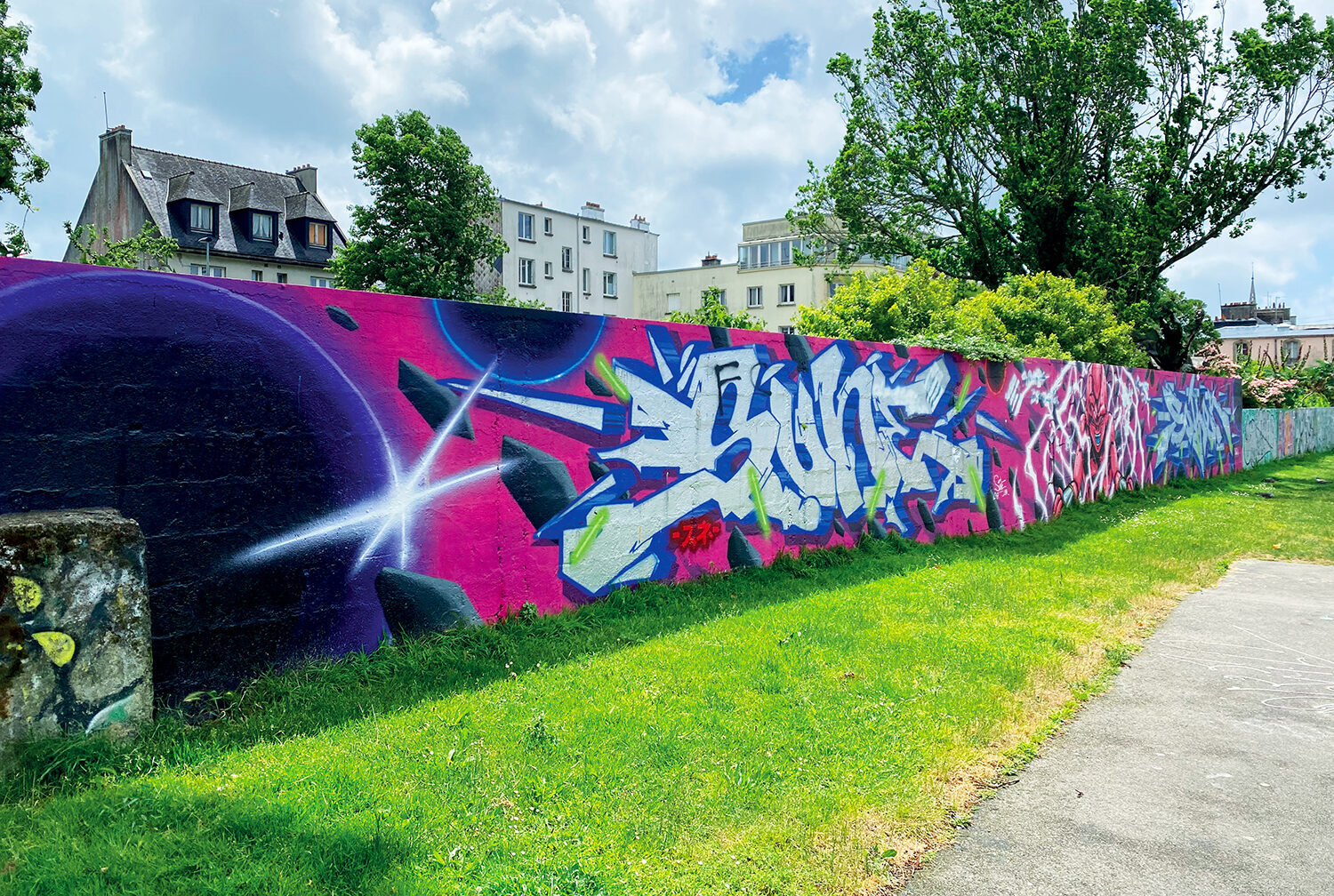
Brest: Graffiti as a Legacy
In this Breton city, street art is not a recent craze. Graffiti began to emerge there in the early 1980s, and while it has evolved, it is still very much alive.
As graffiti artists began to make their mark in Paris, a local scene took shape around the first crews, taking over abandoned lots, railroad tracks, and—above all—the commercial port. This history gave rise to several artists who are still active today, and has gradually been enriched by large-scale murals and projects supported by the city. This longevity gives Brest a special place in the French urban art scene and has helped change the way the city is perceived. “For a long time, Brest was considered an ‘ugly city.’ Tourists came to explore the region but rarely stopped in Brest. Today, they’re more likely to spend a day here. Street art is contributing to this change in image,” notes Caroline Jacq, a Brest-based tour guide who created urban art tours. It’s another way to explore the city, but also to understand how a culture that originated and developed on the fringes for so long has ultimately become an integral part of its identity.


Over 40 Years of History
In the spring of 2026, the exhibition “Brest Under the Bombs — A History of Graffiti 1984–2004,” presented by Passerelle at the Cercle Naval, traced the first twenty years of graffiti in Brest through photographs, films, archival materials, and firsthand accounts. The symbolism is powerful: a culture born on the streets, on vacant lots, and often on the fringes of the law has become the subject of research and exhibitions. For Brest was among the first French cities to be swept up by graffiti art originating in the United States. Starting in the early 1980s, the presence of American military personnel, the film *Beat Street*, and the TV show *Hip Hop* helped spread its culture. In 1983, Brest’s first hip-hop collective emerged. Ninja Force, Acropol Group, and Bruno and Sane all played a role in the emergence and subsequent spread of this new culture. Graffiti artists took over railroad tracks, vacant lots, industrial buildings, and abandoned walls. But the commercial port quickly became their primary canvas. Starting in 1994, the BZH crew—Mel, WCA2, Serk, Jone, and Malik—created large murals there, soon joined by other groups. By the end of the decade, the area’s reputation had spread far beyond Brest. Starting in the late 2000s, crews—including C29—grew in strength, and the jam sessions at the commercial port brought together an ever-wider range of artists. The 2000 event, which brought together graffiti artists from all over France and Belgium, cemented this rise in prominence. Long before today’s monumental murals, Brest already had a genuine, structured, and recognized graffiti culture.
From Graffiti to XXL
Walls Starting in the 2000s, graffiti in Brest took on a new dimension. Without disappearing from its historic neighborhoods, it spread more widely across the city’s walls through projects involving residents, organizations, and institutions. Launched in 2000 on the Right Bank, in the Quatre-Moulins neighborhood, the project “Les murs prennent la parole” paved the way. Eleven murals were created primarily around Anatole-France Street, as part of a project blending artistic creation, neighborhood heritage, and improvements to the living environment. Residents participated in planning meetings, while one component of the project was dedicated to the integration and training of young people. Mural art thus became a tool for urban transformation and local participation.
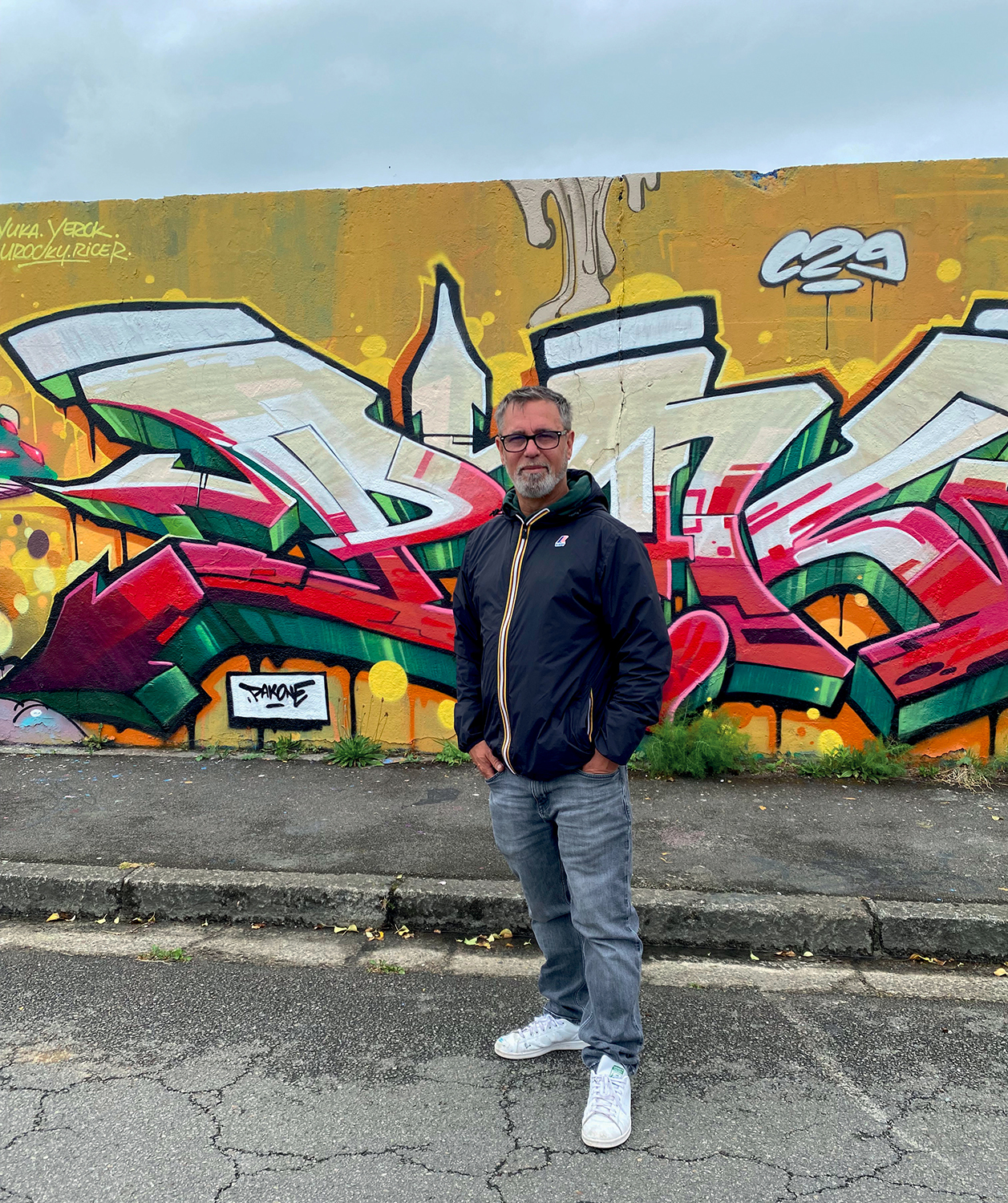
In 2011, “Crimes of Mind” sparked another shift. Led by Brest-based graffiti artist Liliwenn and the Sugar Rush association, 26 French and international artists created 21 murals in various neighborhoods over the course of two years. The goal? To make street art accessible to as many people as possible and to forge connections with residents. Above all, the project opened Brest up to street art and the international mural movement. A scene that had previously been largely centered around graffiti and crews began to embrace new practices and artists from outside the city. Several works are still on display, while a book and a film have documented the adventure. At the same time, artists such as Pakone, Wen2, Jone, Worm, and Royalti are each asserting their own artistic language, while collectives like Cartel 29 and Crazy Partners are carrying on a culture of collaborative work inherited from graffiti.
A New Momentum
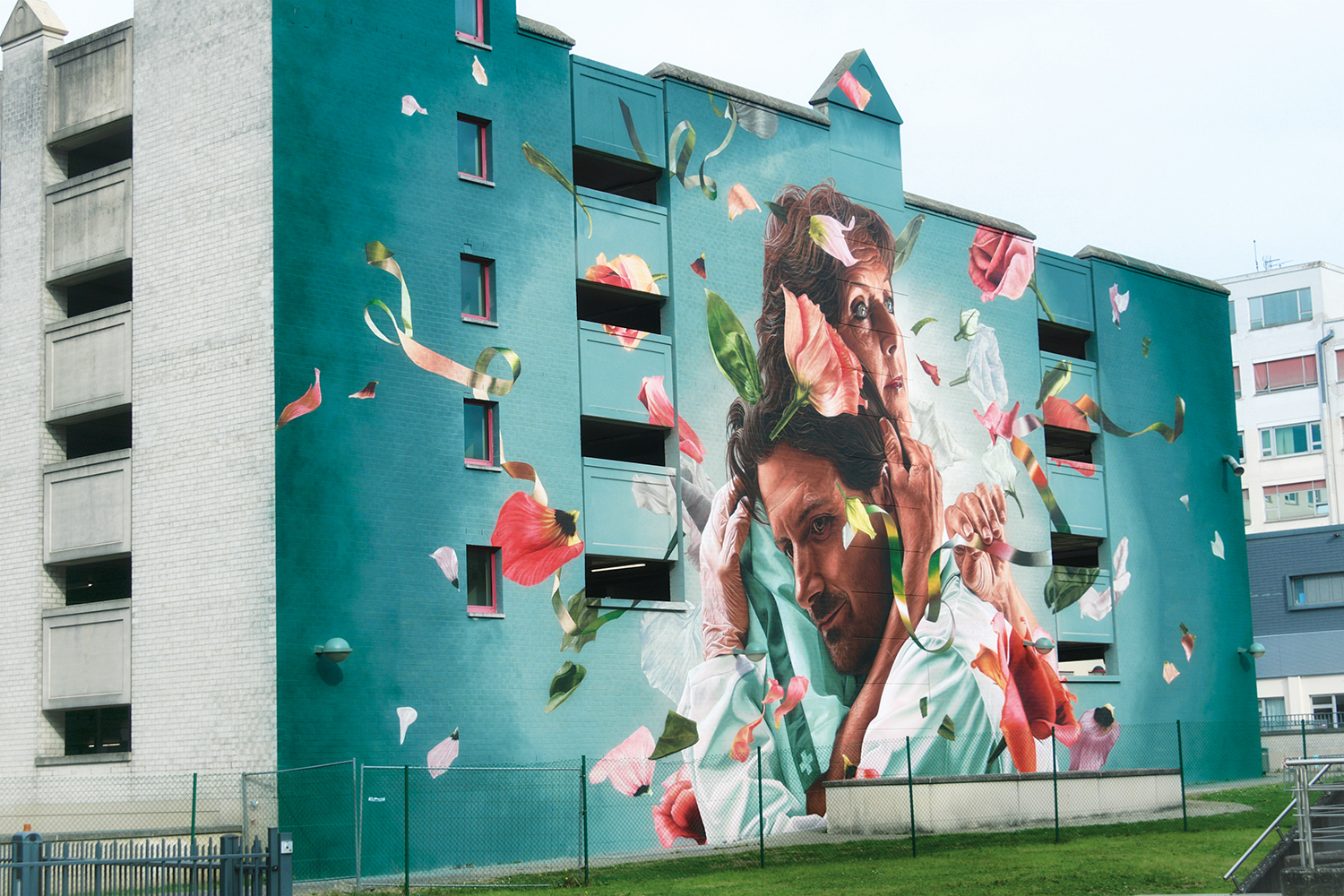
After a period marked by fewer large-scale collective projects, the early 2020s brought renewed momentum. In 2021, the association Projet 0.0, in partnership with Le Spote, took over a former post office building on Rue Algésiras that was slated for demolition. Nearly 4,000 m² became a temporary canvas for some thirty female and male graffiti artists, reviving a historic practice: temporarily occupying vacant spaces. With “Hors les murs,” the shift in scale was even more spectacular. A winner of Brest’s participatory budgeting initiative in 2022, the program calls for a monumental mural in each of the city’s seven neighborhoods. Beyond the artworks themselves, Projet 0.0 focuses on education and resident involvement, particularly in the selection of certain projects. More free-form or temporary art forms, however, remain very much present. In March 2026, Terminus B23 took over former train station buildings to host temporary art installations and exhibitions. Brest now sees spontaneous graffiti, temporary takeovers, participatory projects, and monumental murals coexisting side by side.
Urban
Walks Over the decades, Brest has thus amassed a remarkable heritage of urban art. “I love the diversity between these large murals—which are fantastic—and these more low-key pieces of graffiti, which are often creative and very interesting. On my walks, I mix the two, which also allows me to avoid the typical tours focused on World War II—which are impossible to avoid—and to follow a parallel route, discovering places that are a bit off the beaten path and away from the crowds.” Caroline Jacq likes to start with Kerfautras. As early as the late 1980s and early 1990s, the site’s walls and outdoor spaces were already serving as a canvas for the first graffiti crews. “Right in the heart of downtown, it’s a training ground for young graffiti artists. It’s very diverse and constantly changing.”
Next, it’s impossible to overlook the commercial port, one of the historic hotspots of Brest’s graffiti scene, where part of the city’s reputation was forged, even though the neighborhood has changed dramatically. “At first, it was all overgrown; it was a somewhat seedy area where locals didn’t spend much time. Little by little, the neighborhood has become more attractive. Today, there’s less experimentation, more foot traffic, and more buildings.” Just a few steps from the harbor, the more off-the-beaten-path Merle Blanc offers a different experience. Sheltered from traffic, the street retains a more free-spirited atmosphere. “Graffiti artists try all sorts of things here. There are always some with their spray cans, and this is perhaps one of the spots that changes most often.” In addition to these historic sites, large murals are displayed throughout several neighborhoods, completing a landscape where enduring works, monumental commissions, and constantly repainted walls coexist.
The Soul of a City
The Brest landscape, in fact, is constantly changing. “Before each visit, I have to retrace my route to refresh my knowledge. There’s always something going on. In some slightly off-the-beaten-path spots, graffiti artists can stay for half a day or a whole day and experiment!” This presence doesn’t preclude reactions—sometimes strong ones. Caroline Jacq recalls a piece by Riko Samba Samba on the Recouvrance Bridge—a large heart made up of stenciled chickens and insects—to which someone had added: “Brest has already been bombed in the past—no need to add to it.” The city chose to leave this comment in place…
But that doesn’t stop urban art from being firmly rooted in the city. Residents are involved in certain projects, monumental murals have found their place in the landscape, and the history of Brest’s graffiti scene is itself beginning to be documented and exhibited. In just over forty years, graffiti has thus moved from brownfields and the commercial port to large building facades, participatory projects, and exhibition spaces—without losing what originally made it so powerful: available spaces, free expression, and a scene that continues to reinvent itself. This is undoubtedly what makes Brest unique: having made graffiti a part of its history without, however, freezing it in time.