Walls & Love is bringing the town to life
With its monumental murals and temporary artworks, Walls & Love has established urban art as part of Valence’s cultural heritage.
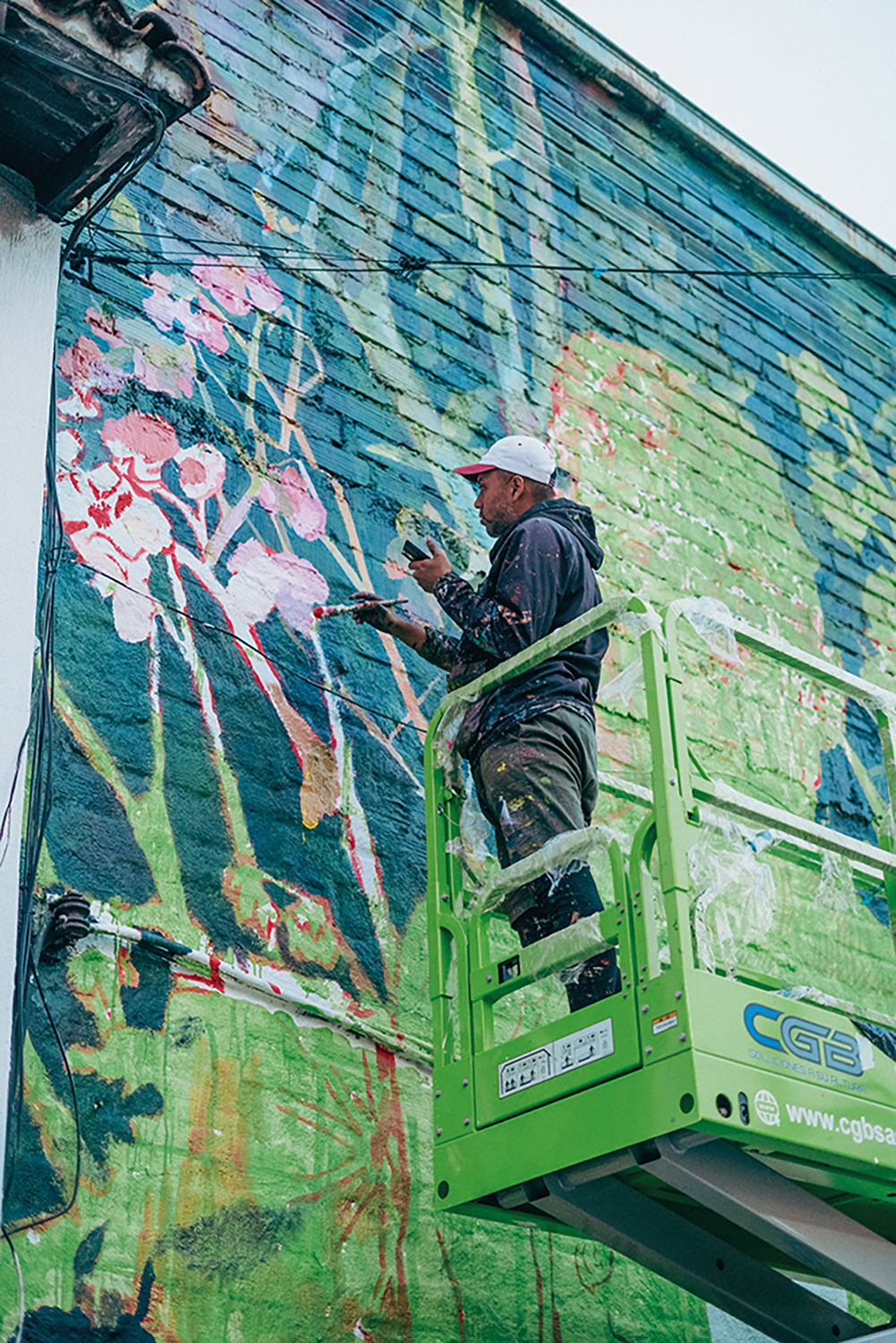
Building on the legacy of an earlier initiative called Wall & Love, the Walls & Love festival has established itself thanks to the tenacity of a collective of artists led by Vincent Lausade, aka Sowan, and the ongoing support of the city of Valence. Three weeks of painting, encounters, and shared moments now bring the city’s facades to life. A true cultural landmark, the festival upholds a clear guiding principle: to showcase the diversity of urban art forms, to use them as a catalyst for dialogue and openness, and to permanently embed the works within the urban social fabric.


How did the Walls & Love festival come about?
It was conceived during the lockdown, driven by my desire to create a powerful artistic project in Valence. Originally, I had envisioned traveling modules so that the murals could move from neighborhood to neighborhood. Although the city government showed interest right away, the idea never came to fruition. In the meantime, a property owner offered us a wall located right in the heart of the city for our first project in 2021, which was renewed in 2022. In 2023, together with Benoît Humbert, we founded the Wall & Love association and launched the festival of the same name. But after two editions—2023 and 2024—we parted ways. I wanted to continue, but he didn’t, forbidding me from keeping the same name. So this year, I launched Walls & Love, of which I am the artistic director. The festival is now run by the Sorry Graffiti collective—composed of 10 professional artists—which I founded and for which I serve as spokesperson, and which is affiliated with the TBM Association, of which I am president. I know, it’s a bit of a tangled web…
What is the guiding principle behind your artistic programming?
The programming is deliberately eclectic. By showcasing a variety of approaches, sensibilities, and artistic styles, we aim to broaden perspectives. Underlying this is a desire to introduce the public to the diversity of street art and muralism. Presenting these monumental works in public spaces is like sowing images that, little by little, enrich our visual experience. While a wall inherently separates, our ambition is to turn it into a place that brings people together. Thus, on the street, a mural becomes an opportunity for passersby to stop, interact, and talk to one another.
How do you select the artists?
We generally use an open call for submissions, but we sometimes invite artists whose work we know and appreciate… a deliberate choice to maintain continuity. This year, due to time constraints, I opted for a different approach by selecting artists who are not currently active on the regional scene. The goal is twofold: to offer art lovers the opportunity to discover new artists in Valence and to enrich the region’s artistic landscape, notably with three permanent monumental murals.
Which artists created this year’s permanent murals?
The Parisian duo Ensemble Réel, the Italian artist Soda, and the Moroccan artist Tima. This selection always stems from a dialogue between an artist’s style and a wall—its location, its “texture,” and its history. For while the artists have carte blanche, their artistic vision must still resonate with the site. Thus, Ensemble Réel worked on an old, weathered wall on Rue Châteauvert, marked by layers of repainted billboards. I knew this 120-square-meter surface would appeal to them, as their artistic practice finds a direct echo there. They chose to leave the patina intact. For Soda, the city provided a 100-square-meter wall at the Zammit gymnasium, located near the train station. A raw architectural structure, made of concrete and metal, that his visual style could enhance. In fact, it wasn’t my English or my Italian that convinced him, but rather the wall I had in mind for him [laughs]. I entrusted the third 80-square-meter wall, owned by our partner Valence Romans Habitat, to Tima, a young Moroccan artist I spotted at a festival, who created her first mural in France here. The wall’s hue naturally complemented her color palette and compositions. Her project, which anchored a monumental mural in a working-class neighborhood, was accompanied by community outreach: shared coffee breaks with residents, exchanges with schools, and a focus on the local fabric. Tima’s presence also met a diversity requirement, as the festival aimed for gender parity.
The festival also features temporary artworks…
Yes. Just like in the first edition, we’ve repurposed the support structure of an old kiosk right in the city center, in partnership with the Valence Chamber of Commerce. With each edition, it serves as a reminder of the very essence of graffiti. Repainted several times throughout the festival, it set the tone for the event from opening to closing. The novelty this year was inviting artist duos to reaffirm the collective nature of the practice: Jerc and Fokus, Boye and Votour, Lemak and Miets. Only Klemz, as a guest and outsider to the collective, worked solo. His mural will remain on display for a year. This experience opens up possibilities for unlikely duos between two artists with very different artistic worlds on a monumental mural… A dialogue I hope to develop in future editions.
What was new about the 2025 edition?
A graffiti jam: a collective activity where several artists paint simultaneously. This format, which is fundamental to graffiti culture but increasingly rare today, seemed essential to me. It’s also a way of honoring the history of the Sorry Graffiti collective, which has long been accustomed to painting together under the Lônes Bridge. The jam brought together Braga, Nyota, Votour, Jerc, Amsted, and Fuego on the wall of the C. Seignobos school. We held workshops there with the students. The entire school was repainted, drawing an enthusiastic response from teachers, families, and students.
And what were the highlights?
The cocktail reception held in front of the Ensemble Réel mural. Together with the Bulles & Barule mobile bar, we created a pop-up gathering spot where neighborhood residents—whom we’d already met during the creation of the mural—came back to share a drink, chat, and meet the artists. Another highlight: the festival’s closing event at the foot of the mural created in 2023 by Ciclope, featuring an evening that brought together neighborhood bars, a live painting session on a vehicle, and DJs from the local electronic music scene. Finally, an outdoor exhibition showcased twenty photographs by the photography collective Les Chasseurs d’images Valentinois, who documented the festival from start to finish. This juxtaposition of the murals with their photographic record offered a fresh perspective on the event, while highlighting the work of local photographers. Three weeks punctuated by these shared moments!
What do you offer the guest artists?
Beyond providing for their practical needs and covering their expenses, we strive above all to give them a warm, family-like welcome, even though they stay at a hotel. We want the artists to feel at home, as part of a close-knit team. I’m supported by my brother Jerc, my partner, the collective, and friends, and this sense of community permeates the entire festival. The setting—a small town—further enhances this closeness. Here, everyone knows each other, and the artists experience both a creative process and a human adventure. Evenings spent together at restaurants are an opportunity to introduce them to local cuisine and create memorable moments.
What role do your partners play?
The city, which funds nearly 70% of the festival, Valence Romans Habitat, the Valence Chamber of Commerce, and all our partners place their complete trust in us: no prior approval is required, and no proposals need to be submitted. This freedom is invaluable; it allows us to build a coherent and ambitious program without compromise. The tourist office has even included the murals on Valence’s official map, alongside the monuments, thereby recognizing their heritage value. All of this support helps to firmly establish the project within the city’s landscape.
So artists face no restrictions, but are they aware that they cannot express everything in public spaces?
We do not seek to provoke tensions or pit communities or ways of thinking against one another. But we don’t hold back! Some works, in fact, convey a humanistic message or reveal the fragility of nature in an intrinsic, rather than overt, way. I like to point out that the act of painting a facade is in itself a committed gesture: it brings residents together around a mural in progress, inviting them to stop, share a coffee or tea, and chat… Creating connections and fostering encounters—that is our most constant commitment.
Unlike last year, when you painted a monumental 190-square-meter mural, this year you were solely an organizer. Was that a conscious choice?
Yes, it was a deliberate choice because I find fulfillment in my painting practice, my occasional contributions to other festivals, and my role as a teacher. Organizing Walls & Love fulfills another desire: to take initiative, create an event in Valence, seize the opportunities the city offers, and foster meaningful connections. A slice of life, an experience that is, above all, human…
Do you already have the next edition in mind?
Nothing is set in stone, but things are starting to take shape. First, we’ll take the time to talk with the team: their feedback, which is always invaluable, helps shape the festival’s evolution. The monumental murals will remain at the heart of the project—three or four at most—because they leave their mark on the area and anchor the event in the city. But it’s important not to let things get out of hand so that Walls & Love remains a deeply enriching experience. The jam session will return, as it has proven its value. We also want to better highlight these moments of life at the foot of the murals by scheduling them as true highlights. Finally, opening up to other disciplines—dance, theater, visual arts…—in collaboration with local organizations will allow us to further expand the scope of our encounters. The ambition remains: to offer moments of creation and sharing that bring a little joy during a difficult time.