Mr. Cenz in Paris for Verticle 75
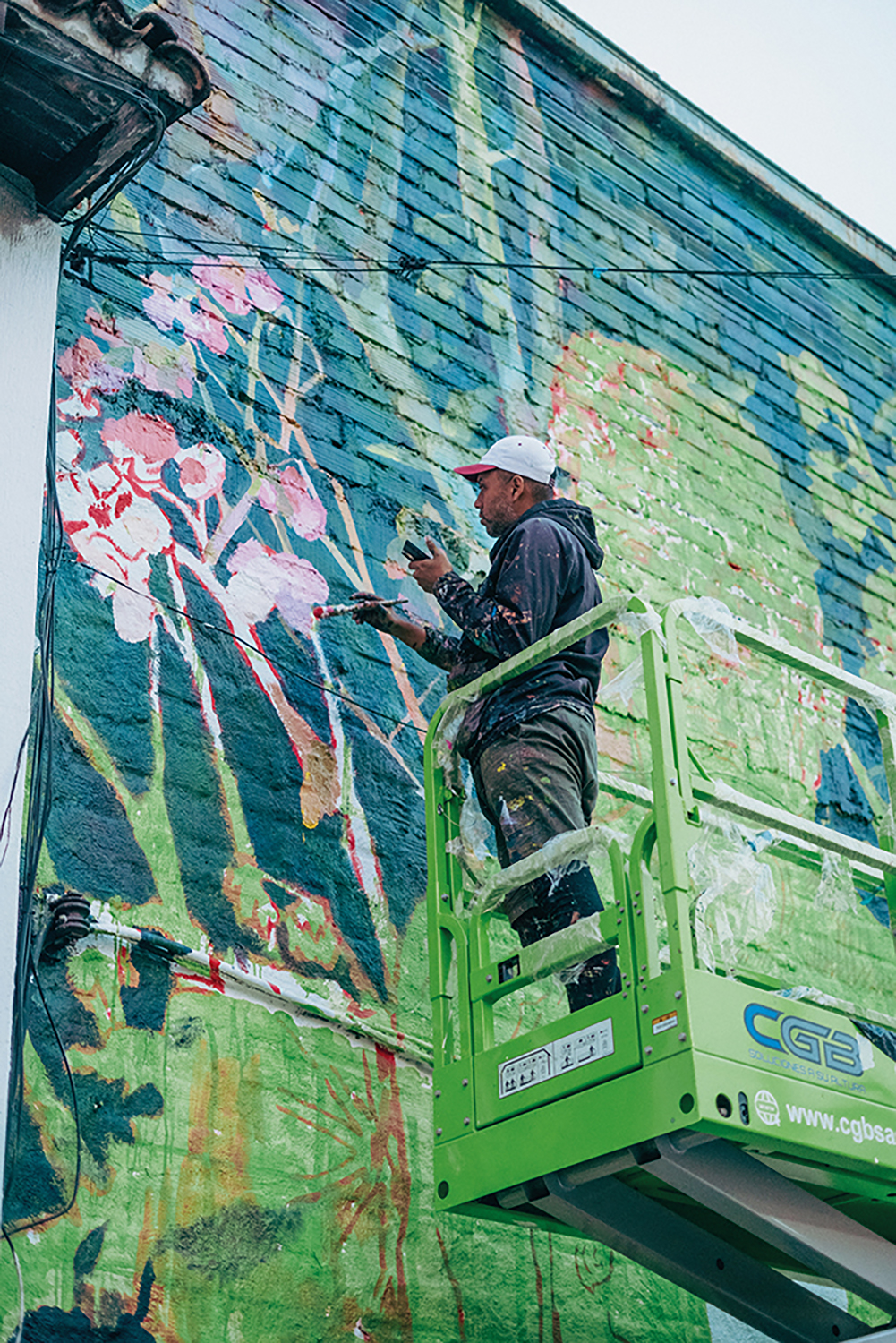
At the invitation of David Roos and Eddie Colla, the British artist set up his spray cans on Rue Poissonnière, in the midst of a summer heat wave, to paint one of his powerful and mysterious portraits of a woman on a Parisian wall; it will be on display through September.
Mr. Cenz, also known as Julian Phetean, has been painting since he was 11 years old. Over the course of his 40-year career, he has developed a distinctive style. Working from photographs—primarily of female subjects—he reinterprets them in a unique way through compositions that blend technically perfect figurative art with an abstract approach to shapes, lines, and colors. An approach sometimes described as “surrealist graffiti for the soul”!


You have a style unlike any other…
There are no shortcuts to finding your own style—it takes a lot of work—but it has to come naturally, without trying to copy what others do. This ethos, which was at the heart of graffiti in its early days, has unfortunately been lost. Today, many people are content to simply piece together elements borrowed from other artists’ work. Developing a personal identity remains essential, however; so I feel lucky to have found my own.
Why do you mainly paint women’s faces?
I love women, of course, and I’m lucky to be surrounded by extraordinary women. Artistically and aesthetically, I’m drawn to the shapes and curves of the female body and face; they harmonize with those of graffiti letters. And once you start painting faces, it becomes almost addictive. Everything you can convey through a glance is very powerful.
How did you choose the subject of this mural?
David and Eddie gave me complete freedom, which I really appreciate. I always work from a reference image, but never from photographs of famous people, and I choose my subjects very carefully. Here, the model is young and seems deeply absorbed in the music she’s listening to. I believe music is important for coping with the madness of life, especially today. I’m not necessarily trying to convey a specific message, but I think everyone can interpret many things in my work.
How do you make the transition from photography to mural painting?
I paint entirely freestyle [laughs], without planning anything, without any preparatory drawings or sketches. It all happens in my head. I visualize what I want to do, mentally adjusting the shapes, colors, and composition. Then I grab my spray cans and just go for it. I don’t try to figure out, by looking at the photograph, how I’m going to reproduce it on the wall. I don’t overthink it; I adapt to the space. That’s part of being a street artist, isn’t it?
Do you paint only with spray paint and freehand?
Yes, almost exclusively. I use tape to draw straight lines and, sometimes, a brush to accentuate certain effects. When I first used a spray can, I was fascinated by this technique and sought to push its boundaries.
When I was younger, and later as a student at the Academy of Fine Arts, I experimented with other mediums, like pastels and acrylics… But nothing compares to spray paint, which is ideal for my spontaneous and free-form approach, whether on a wall or a canvas. Very large walls naturally require a bit more preparation, but, deep down, I tackle them the same way. Having enough self-confidence to work freestyle on a large scale isn’t easy; it took me years to get there.
Even though you break away from strict realism, your works demonstrate impressive technical mastery. How do you achieve this result with spray paint?
There’s no secret… it takes a lot of practice [laughs]. You can’t master a discipline without dedicating time to it and fully committing yourself. I appreciate certain aspects of photorealism, but I also find overly accurate depictions boring. You have to bring something personal to it. That’s why I seek to combine this technical mastery with my love for abstract and futuristic art. I’ve always loved exploring the world of graffiti and fusing it with other art forms, long before it became popular.
Attention to detail is evident throughout your work…
Yes, I always place a lot of importance on details, even when I’m painting thirty meters up in the air and no one can see them!
How long did it take you to paint this mural?
Two days. Because of the heat, I had to start early to avoid finishing too late, and I worked a little slower than usual [laughs].
This piece will remain on display for three months. Isn’t that a little frustrating?
That’s part of the very nature of urban art. As soon as a piece is out on the street, it no longer belongs to you. It could be tagged the very next day. It’s a risk we’re aware of and accept. When you paint in public spaces, you can’t let worry or frustration get to you.
Check out
Verticle 75
, 7 rue du Croissant, 75002 Paris
. Instagram: @verticle75
Mr. Cenz: mrcenz.com
Instagram: @mrcenzone