Rouen, an impressive city
The transformation of the city through urban art is inextricably linked to “Rouen Impressionnée,” a triennial event that debuted in 2010 as part of the Normandie Impressionniste festival. While the first two editions focused on contemporary art installations and sculpture, the third, in 2016, marked a decisive turning point. Olivier Landes, founder of the Art en Ville association, which develops urban art projects primarily for local governments, has served as curator and artistic director of “Rouen Impressionnée” since that pivotal edition: “The people of Rouen spotted me during my first major project, the In Situ ArtFestival at Fort d’Aubervilliers in 2014, when they were looking to do something around street art at the time. 2016 truly marked a turning point, with some fifteen murals, including works by world-renowned artists such as
SatOne, Sainer, and Brusk, who left a lasting impression. Since then, we’ve seen—if not a flood, then at least—numerous commissions for artworks not only in Rouen but also in nearby towns like Maromme and Petit Quevilly. We’ve seen that we can create beautiful things, and there’s been a great momentum ever since, which is really taking off with this new edition.”
 Urban Landscape
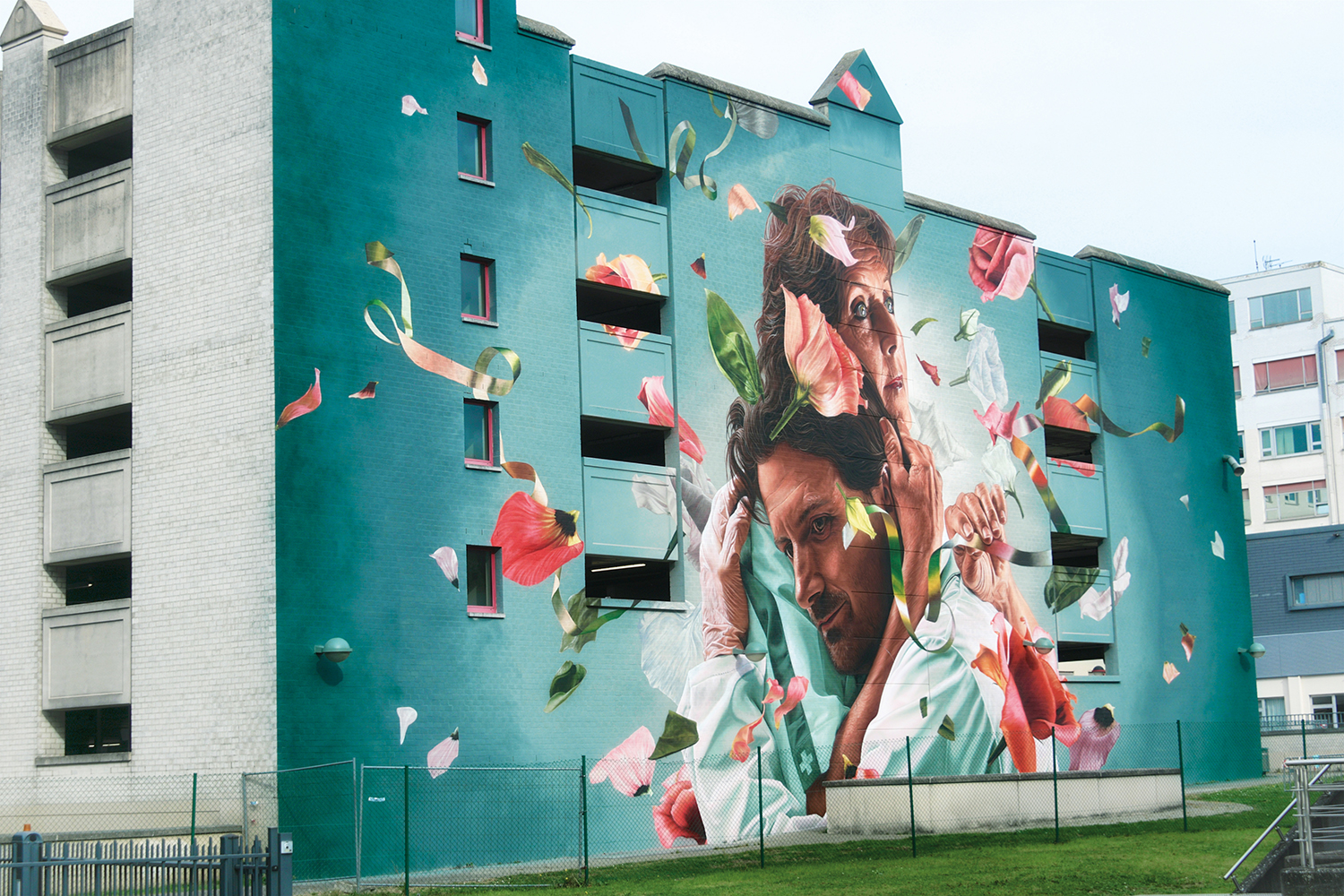
Between 2016 and 2020, the two editions of “Rouen Impressionnée” have thus bequeathed to the city one of the finest collections of contemporary art in France, with some thirty high-caliber murals throughout the city. The monumental murals have naturally found their ideal setting in the newer outlying neighborhoods. “In 2016, we focused mainly on the docks and the port of Rouen and the Sapins neighborhood. For 2020, we’re moving to the left bank of the Seine, in the Grammont and Saint-Sever neighborhoods, which feature
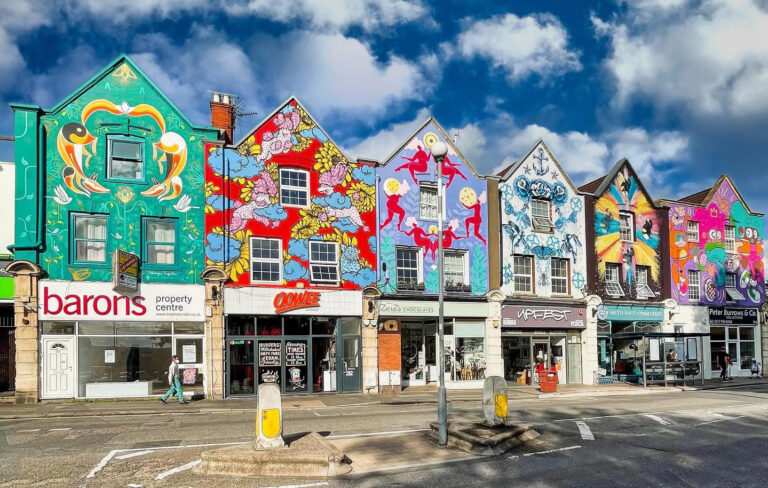
a very eclectic mix of architecture from all eras,” explains Olivier Landes. That said, street art is not absent from the city’s oldest neighborhoods, with their cobblestone streets and historic buildings. You can discover shop facades decorated on Rue des Bons Enfants, ERDF transformers repainted in flashy colors in the city center, a mural by Jef Aerosol on a half-timbered house, and a mailbox painted by C215 on Rue du Gros-Horloge, right in the heart of the city. This year, a major event will even take place there as part of the festival. “The Franco-German artist Jan Vormann, who fills the cracks in old buildings with Legos and whose Dispatchwork project is now being replicated worldwide in a participatory manner, will be working on the Palais de Justice, a building constructed in the early 16th century that was severely damaged by bombing during World War II. Proof that a compromise is possible between historical heritage and Urban Art—ephemeral in this case.” To discover the full richness of Urban Art in Rouen, you should visit the most famous spots, but also don’t hesitate to get lost in the narrow streets and look up.
 Global Stars and Local Artists
For Olivier Landes, certain works by the most renowned French and international artists are must-sees. “From the 2016 edition, I’d particularly highlight Less Than A Second, an abstract piece by SatOne on Hangar 23, and the Countryside Evening mural painted on a wall of the Isigny building. This year, don’t miss Roid’s work on the walls of the former France 3 Normandie offices, which makes magnificent use of this 1990s architecture with its multiple volumes.” Also worth mentioning are the Argentine artist Elian Chali, who created a vast anamorphic painting on a set of three adjoining pavilions; street artist Manolo Mesa, who painted a bourgeois house; and the trompe-l’oeil work by Italian painter Roberto Ciredz. “Rouen Impressionnée” also gives significant prominence to the local scene. “The spirit of the festival is to offer a program with about one-third international artists, one-third established French artists, and one-third local artists. This year, we organized an exhibition, ‘35 Years of Graffiti and Street Art in Rouen,’ which dates back to 2005. Hip-hop culture swept through Rouen, just as it did in cities across France and Europe in the 1980s,” explains Olivier Landes. Rouen has seen the rise of many artists such as LKSIR, Dhoa, Method Graphic, Padame, Ise, Madcow, and Ecloz, and several collectives bring together local artists, such as the A31 Collective. As a result, local contributors have left their mark on the 2020 edition. “The Rouen-based collective HSH painted the MJC with a stunning mosaic of ideas. Savati created a monumental 18-panel collage depicting a figure gradually disintegrating. Finally, those who can visit Rouen in the coming months will be able to discover the largest knitted piece ever created: the Citémômes collective wrapped a house on the Left Bank in some 28,500 squares of wool.” For the festival’s artistic director, this mix of local and international artists is incredibly enriching. “When I told the graffiti artists in Rouen that Roid was coming this year, they were like rock musicians who’d just been told the Stones were coming! For the creation of his colossal mural, which spans several hundred square meters, artists from Rouen spontaneously came to help his team. And one evening, Roid felt like doing some wild graffiti. The local graffiti artists found a nice spot on a vacant lot and went to paint together, just for fun, like musicians jamming after a concert.”
 An Active Urban Scene
A devoted Norman and, in his own words, a true Rouen native, 33-year-old Paul Delahaye opened the city’s first gallery dedicated to street art, Outsiders Galerie. “Street Art has been a passion of mine since I was a teenager. While I was working in real estate, I had a painter friend in Rouen; I bought quite a few of his paintings and thought it was a shame there wasn’t a place that showcased this kind of work. I had the opportunity to buy a small space in the antique district, and that’s how I got started.” Success has followed, as the gallery has grown from its first 20-square-meter shop in 2015 to a 150-square-meter space on Rue de la République, and a new 300-square-meter space on Rue Saint-Denis has just opened. Proof that there is a dynamic local market. “The clientele in Rouen is by far the most dynamic. They are the most engaged, the most discerning, the most educated, and the ones who follow artists the most closely. I had a gallery in Lyon that I’m in the process of selling because I want to focus on Normandy, particularly the coast. In fact, we’re opening a new gallery in the city’s historic center in October, Delahaye & Giordani, which will feature nationally and internationally renowned artists, because there’s a real demand here.” Paul is also behind the M.U.R. in Rouen, which opened last May and is set to host a new artist roughly every month and a half, for a total of seven works a year. “About a hundred meters from the gallery, on Rue Alsace-Lorraine, there was this ugly wall. Now it has become a meeting place for street artists and the public, a window for free expression for the selected artists.” Prisme, a 31-year-old native of Rouen, had the privilege of being the first to paint on this new space. And other artists from Normandy, such as Piotre (Caen), Mathieu Questel (Rouen), and Homek (Lisieux), are part of the lineup. “There is a very vibrant local scene in Rouen, and more broadly across the region. It must be said that the city is very active and supports the development of urban art. For example, with the M.U.R. project, we had no issues at all, and the city was fully behind us. This local scene has always existed, but over the past five years—because we have walls, venues, and galleries—it has naturally become more visible. What I find appealing is that there’s a great synergy among all these artists: it’s not a “turf war,” but rather a virtuous circle, with a real team spirit. Everyone knows each other, with a friendly atmosphere that lifts everyone up.”
 Artists involved
Mathieu Quesnel, born in Rouen in 1981, a graffiti enthusiast who dabbled in digital art before returning to painting, is one of the rising stars of the local scene, which is home to an increasing number of urban artists whom he is the first to appreciate. “Personally, I really appreciate the work of Ratur & Sckaro as well as the themes they explore. They blend their work well between street culture and contemporary art.” For him, the dynamism of the Norman city is undeniable. “I’ve sensed a revival over the past five years in graffiti and urban art, bridging the new generation with the older one, which is making a strong comeback.” This growth in street art is linked to the city’s cultural development centered on urban and contemporary art. ‘Rouen Impressionnée’ has introduced the public to many international artists. And venues like Hangar 107 or the Outsiders Gallery contribute to the visibility and openness of the street art scene.” Although he now focuses on canvases, Mathieu has just completed a mural on the M.U.R. “I think that today, it’s important for an artist to make a name for themselves through mediums other than their canvases. The street is also a wonderful showcase for promoting one’s work in their city, especially for people who don’t frequent galleries. The M.U.R. in Rouen is a great opportunity to make a name for oneself and express oneself locally. In my opinion, it’s essential to be active in the city you love, because the artist’s proximity allows them to make an impact in the short and medium to long term.” This approach is shared by many street artists in Normandy and helps make Rouen a city where urban art is alive and thriving.
[button color="black" size="normal" alignment="none" rel="follow" openin="samewindow" url="https://phoenix-publications.com/produit/urban-arts-magazine-7-copie/"]Buy [/button]