Agrume, a refreshing touch of tartness
The Lyon-based street artist draws us into his world—both dreamlike
and firmly rooted in reality—which reflects on our place in the universe, our relationship with time and nature, and our encounters with deception and mystery.
Agrume: agrume-art.com
Instagram: @agrume_


Since his artist residency in Rillieux-la-Pape in 2016 as part of the Horizons Croisés project, Alban Rotival—who will turn thirty next year—has made a name for himself. This self-proclaimed multidisciplinary artist has staged a series of solo gallery shows and public installations, gently establishing the unique atmosphere of his work. In these works, the figure—often himself—does not take center stage but blends into the urban environment, hiding behind flowers, birds, or butterflies.
Why did you switch from illustration to street art?
Illustration was the very first form of visual expression I discovered—and undoubtedly the most accessible; all I needed was a ballpoint pen and a sheet of paper. Later, while exploring cities like Lyon and Paris, I discovered the paintings, collages, and mosaics that dot certain neighborhoods. Art installed in public spaces struck me as an obvious way to expand my artistic practice. It allowed for different formats and techniques. It was a way to move beyond timid, solitary work and offer passersby a painted image in all its diversity. To make my work public, in a way, to speak out visually, and to highlight the importance of this or that thing.
When working outdoors, do you still use collage?
Not exclusively. I work with paint, and the medium defines itself based on the nature of the project. But paper is a medium that evolves and absorbs the traces of time and its surroundings until it fades away, leaving no trace behind. It’s a form of ephemeral expression. That’s why I like to compare collage to speaking out in public spaces. Collage creates a moment, a scene. It conveys an emotion, highlighting something essential that I want to express at the very moment I imagine and paint it. It allows for studio painting that’s as polished as I want it to be. It’s easy to transport and quick to install, no matter the context. So I mostly use collage for completely informal, free, and personal projects. In contrast, murals are created in an official setting or at festivals.
You recently participated in the Urban Week festival at La Défense. Is it different to work outdoors in an official setting?
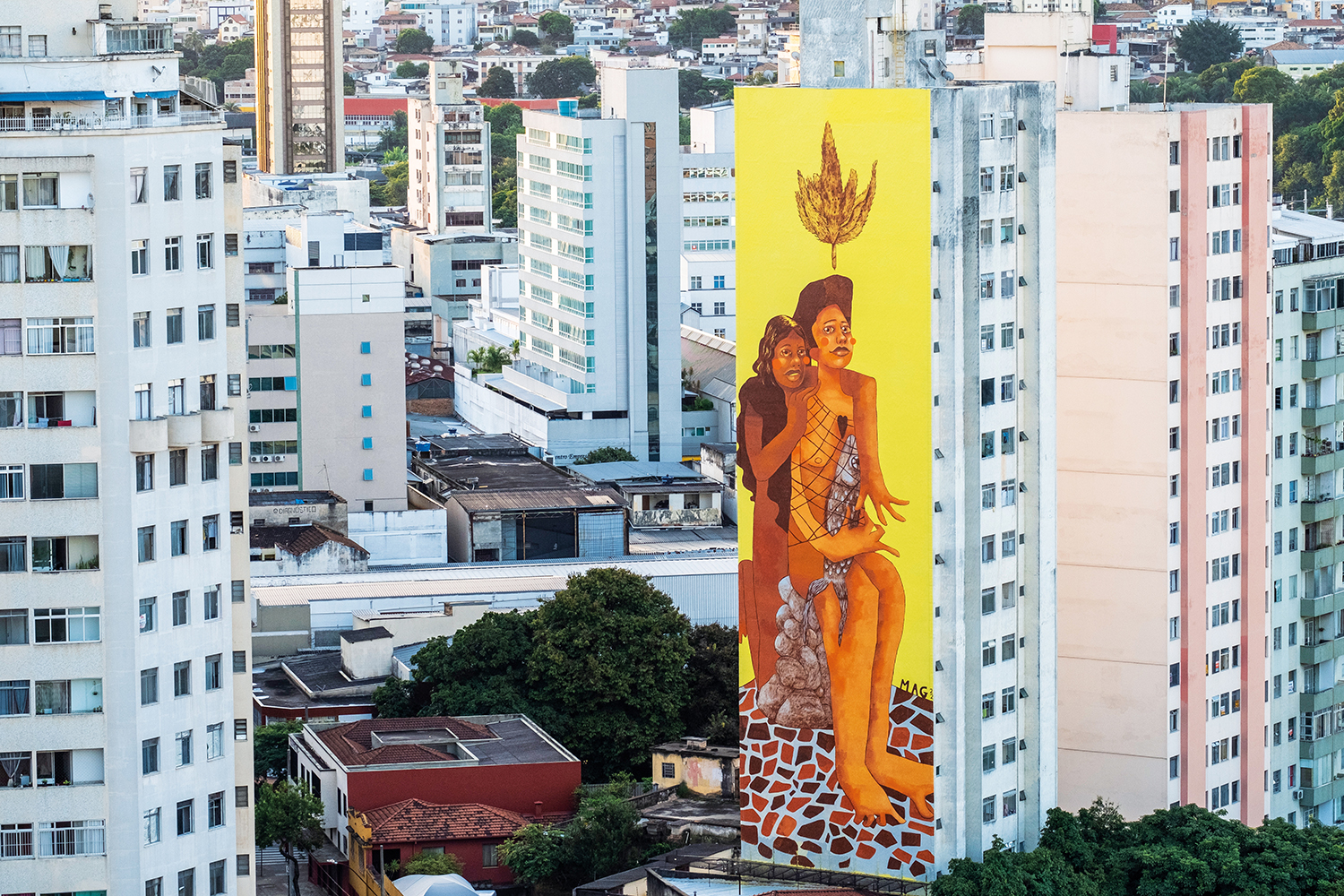
Yes. I created a mural and a series of collages around the La Défense plaza. For the collages, it’s obviously different. The official setting is more comfortable and reassuring, which, in some ways, is nice. On the other hand, I think an official setting limits possibilities and sets boundaries on what can and cannot be expressed or depicted. The preparatory work and the various perspectives on the future project are there to validate the project.
Your artistic practice is multidisciplinary (drawing, painting, collage, writing). How do you balance these different approaches?
I think the place where I manage to bring all these ways of working together is in my research. I draw, sketch, write down phrases, and note things that catch my attention. I explore and fill up sketchbooks. I try to exhaust my ideas by putting them down on paper, then I select them to focus on what I find interesting to work on and important to show.
How has your practice evolved over time?
Along with my technical and “philosophical” development. I started out drawing in a cartoonish style, then I wanted to expand my artistic vocabulary by depicting human characters whose faces I hid behind masks for both symbolic and technical reasons. Little by little, the mask came off, and today I’m technically comfortable depicting a wider range of subjects. My themes have become more refined as my knowledge and sensitivity have grown. Today, learning about living ecosystems and the beings that inhabit them opens up yet another path for me.
Your studio work is currently focused on oil painting. You’ve “dared” to switch to a classical technique…
I’ve been learning and working on my oil paintings for a year now, without giving up acrylic, which retains its own unique qualities. This technique reveals a wealth of possibilities that I really enjoy. The transparency of the paint and the way light passes through it create different atmospheres.
Why do you often include yourself in your work?
I started doing this when I learned how to depict characters. Taking photos of myself was one of the simplest ways to approach the scenes I had in mind. Little by little, I got into the habit, and the presence of self-portraits became a consistent feature in my compositions and depictions. It became justified by the fact that I address personal feelings in a universal way. But little by little, I’m starting to expand my range of subjects.
Your characters are often partially hidden, and you’ve even titled one of your series *Discretion*. Is that important to you?
Yes. Discretion has always been a part of me, whether in my personal or professional life. So it naturally finds its way into my work. It’s a concept I find rich. It runs counter to that “human clamor” that tends to dominate, damage, and overwhelm its surroundings. In many scenes, I depict one or more characters who strive for discretion in relation to their surroundings through various actions or appearances, the goal being to live and make their presence felt in the world without leaving an indelible mark, to try to exist on the same plane as other living beings, whoever they may be. This ties into certain current issues.
You paint in “projects.” Why do you work this way?
To help me focus and organize my work. I come up with my designs fairly spontaneously and without any set rules in my sketches, and ideas just pop into my head randomly. Then I select them and try to work with recurring themes.
You’ve dedicated a series to Icarus. Is
this a theme that resonates with you? This myth embodies many aspects that speak to me. I love its aesthetic, the connection to the condition of a bird. The presence of wings, the disguise, the beauty of the momentum, of flight, and the tragedy of the fall. I particularly appreciate this myth because it is surprisingly relevant today. I find it a beautiful metaphor for our current society, for its desire for infinite growth in a world of limited resources. A fall that is foretold even as, despite being warned, we continue to draw ever closer to the sun.
Nature—flowers, birds, butterflies—features prominently in your work. Is there a message to be found in this?
They are elements of the living world. Aesthetically, they interest me for what they are and what they symbolize. They all share the common trait of embodying both strength and fragility: strength through their movements and adaptability, their migrations, their vitality; fragility due to their size and weight in relation to the world, their vulnerability to human activities and ignorance. Much like a still life, all three address the transience of things. The lifespan of a butterfly and a flower, the passing of a bird, allow me to play with the idea of the moment.
People often describe your work as dreamlike. Yet it seems firmly rooted in reality…
I believe both aspects are important; they echo and complement each other. My work is completely rooted in reality; it explores it, and each of the scenes I depict is set within it. It approaches the dreamlike because what I create attempts to construct a narrative and a new imaginary world through the combination of narrative elements. The dreamlike is thus itself embedded in reality.
Your work brings Magritte to mind. Is he one of your inspirations?
I don’t have any specific references; every artist is inspiring in what they convey or in the way they do it. Magritte is inspiring in his way of composing and giving meaning to his images through the assembly of elements. What inspires me most is still what I see, what I read, and what I observe. My work today draws more from a swimming swan, the fragrant bloom of wild honeysuckle, or the falling of scarlet leaves from a fustet in the fall. What interests me, then, is how I can integrate these into my artistic vocabulary.
What are your plans?
An exhibition in Paris in 2023. I also have a few more formal mural projects that I’d like to continue developing alongside this, particularly working in natural environments in the most respectful way possible. Deconstructing what defines Urban Art today to arrive at its most ancestral form, returning to a simple mode of expression: drawing on rock with charcoal.